
The Experimental Aircraft Programme, the EAP, was the technology demonstrator behind the Eurofighter Typhoon. Built in Britain during the 1980s, it combined technologies never brought together in a single aircraft before. It proved the hard things early and put us in a strong position to lead the programmes that followed.
Chris Yeo, Former Chief Test Pilot
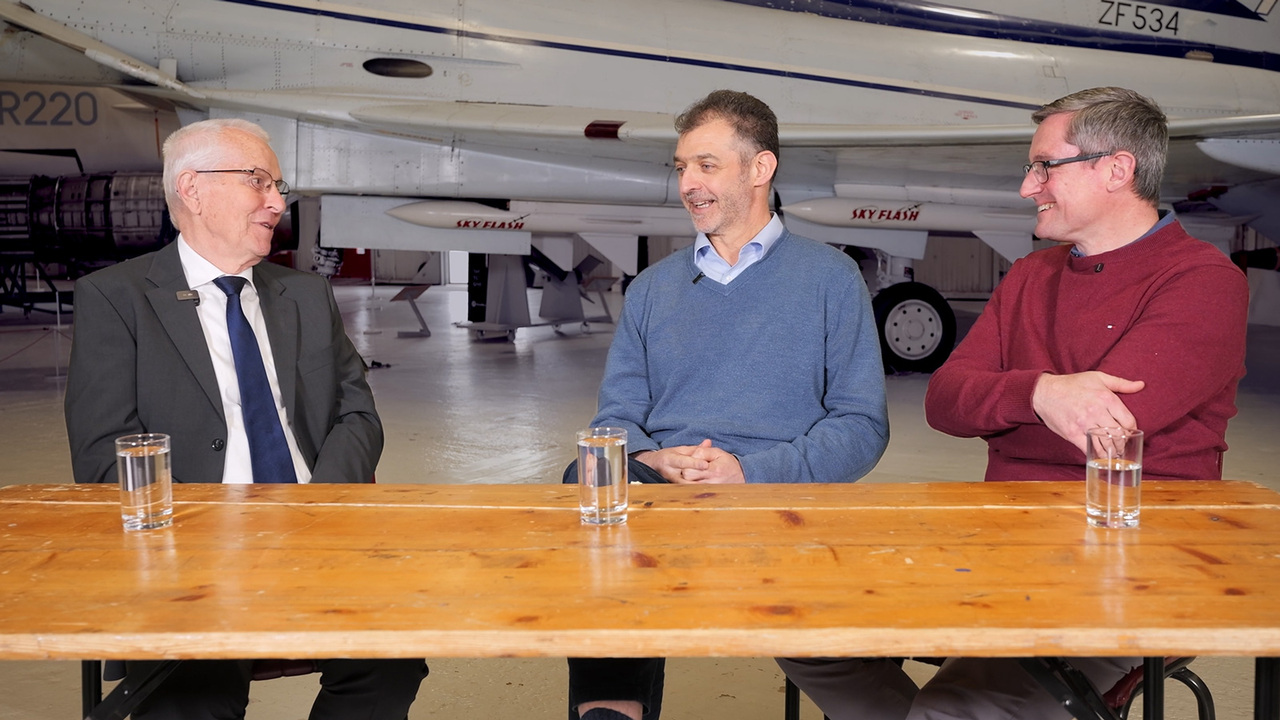
Chris Yeo, Former Chief Test Pilot talks to Steve Fomoso, Head of Flying at BAE Systems and Tony Godbold, FCAS Delivery Director at BAE Systems about his experiences of flying EAP ZF534 and how the technology has informed the course of aircraft development ever since.
EAP Serial No. ZF534
The programme began in May 1983, when our predecessor company, British Aerospace, signed a contract with the British Government for a one-off research aircraft. Its job was to test pioneering technology for an advanced fighter.
From first flight, EAP used a digitally controlled Flight Control System (FCS), which made the technically unstable aircraft very agile and allowed superior manoeuvrability by processing the pilots inputs and commands thousands of times per second. There were no rods linking the control sticks to the flight controls, and the wings were carbon fibre. Those features are standard today. At the time, none of it had been done before.
The EAP existed to prove new technologies for a new generation of fighter. It did this by gathering flight data that ground testing and theory couldn't provide, and by maturing concepts in a realistic environment.
Digital fly-by-wire in an unstable configuration
The design and its control philosophy transferred directly to Eurofighter Typhoon, producing a combat aircraft with exceptional handling.
Advanced composite and metallic materials
Applying composites to large sections of the airframe extended our expertise and expanded our Samlesbury site into a centre of excellence for composite manufacture. That capability later supported Typhoon and the rear fuselages for the F-35 Lightning II.
The Utilities Management System (USMS)
The development of USMS advanced the status of engineering at Warton. It brought power and mechanical engineering into the digital age, made integrated systems possible and opened the door to real-time performance modelling and prognostic and health monitoring systems.
Systems engineering methods and tools
We learned to manage the design process at a scale not attempted before. Those lessons carried into Eurofighter Typhoon, a far more complex multinational weapon system.
Direct voice input and control of aircraft systems
The EAP matured concepts that can't be fully tested on the ground, including voice control of aircraft systems.
The EAP was built by skilled, committed people, and it shaped a generation of them. Many learned on the job, taking short computer courses and applying what they'd learned the next day. By keeping that talent engaged, we retained the skills that moved straight onto the Eurofighter programme.
It energised a generation of engineers, project managers and supplier managers, and paved the way for the greater challenges that would be faced in the Eurofighter programme. Put simply, without EAP, Eurofighter could not have happened.
Dr Nigel Whitehead CBEFormer leader of Military Aircraft, BAE Systems (Retired)
The EAP earned its place in aviation history. It was rolled out at Warton, Lancashire, in April 1986, with employees lining the runway to watch. On 8 August 1986, test pilot Dave Eagles took it to 30,000ft and reached Mach 1.1, faster than the speed of sound. Three weeks later it appeared at the Farnborough Air Show. In June 1987 it flew its 100th flight at the Paris Air Show, having completed 100 flights in 10 months.
Test sorties
Flying hours
Top speed (mach)
Angle of attack
- The clearest measure of its value is what it made possible. The EAP played a crucial role in developing the Eurofighter Typhoon, taking a full year off the development programme and saving £850m. Its influence reached further. The programme passed on technology, skills, processes and techniques in design, manufacturing, testing and qualification. Alongside Typhoon, that experience benefited the Joint Strike Fighter, Hawk and our uncrewed projects, helping keep British and European aerospace at the forefront of military and civil development.
You've set a very high bar for us to live up to, but that heritage through what we do in BAE Systems, that transcends [EAP's] generation.Tony GodboldFCAS Delivery Director, BAE Systems

It was quite early in the development of the aircraft, so it shows a great deal of confidence. We only looped the aircraft on something like flight eight and did some airshow manoeuvres. So the aircraft was flying very early in its life.Chris YeoFormer Chief Test Pilot (on flying at Farnborough International Air Show 1986).

The EAP proved that focused investment in a demonstrator can shape decades of capability. That spirit of innovation isn't only part of our heritage. It's still happening today.
We're applying the same approach to the Tempest aircraft under the Global Combat Air Programme (GCAP), working with partners to develop the next generation of combat air capability. The technologies are different and the challenges are greater, but the principle holds: prove the hard things early, build the skills to deliver them and give a new generation of engineers the confidence to push the boundaries of what we know.
See EAP ZF534 up-close
The airframe of the EAP arrived at the RAF Museum in Cosford, Shropshire in 2012 following its departure from Loughborough University. In February 2014, the airframe was officially donated to the museum to form the centrepiece of a new exhibition featuring the ground-breaking achievements of the aircraft. Visit the museum’s test flight hangar to view the exhibition.
Contact our heritage team
BAE Systems plc